
How Training Works
What is rewards-based training?
Rewards-based training, otherwise known as positive or R+ training, is a method of working with dogs that does not rely on the use of punishment or aversives. Instead, the focus is on motivating learning through rewards - no equipment, no getting physical, nothing nasty needed.


What is 'positive reinforcement'?
For many years, dog owners all over the world have been training their dogs using techniques that came from a variety of sources. When we work with dogs, we use methods that form part of a 'quadrant' - this quadrant covers everything from praise and rewards to physical punishment. Rewards-based training focuses on one section of this quadrant - Positive Reinforcement.
Positive Reinforcement = adding something that the dog finds rewarding as a way of motivating the dog to repeat a certain behaviour. So in other words, if I give my dog a treat every time she does something I like, she's going to be much more likely to repeat that behaviour again in future to earn more treats! Nb: treats are far from the only thing we can use as reinforcement, essentially anything your dog likes could be used for reinforcement! This could include play with toys, sniffing or scentwork, praise and attention, meeting people or other dogs, or even something as simple as giving them their food bowl or opening the back door to let them outside.
How does it work?
This format of rewarding and reinforcing desired behaviour is rooted in science and psychology - if you do a quick google search, you'll find that it's a theory that is also widely used within human psychology; it's not just reserved for training animals!
You can think to your own life for examples of how Positive Reinforcement works - if your boss were to give you a small bonus each time you completed a certain task, surely you'd be more likely to repeat that task whenever possible? Likewise, if all of you work is continually reinforced through praise, you'll likely be more motivated to keep working well.
In contrast, if you don't receive acknowledgement for good work but instead only receive reprimands for poorer work, and in fact are given penalties like docked pay, docked hours, or reduced workplace privileges, you're surely less likely to want to keep working at all, and what work you do complete is going to be less consistent and probably not as good overall.

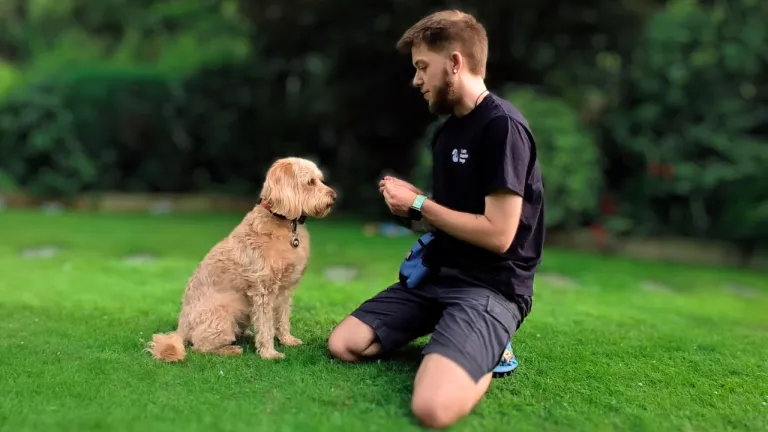
The Key Building Blocks
Training dogs ultimately needs to boil down to communication and building trust. We're working with animals who have no way of understanding the wider context of what we're asking them to do - they don't know why we want them to sit all the time, or why it's important to come back when we call, so it's up to us to help them to at the very least understand clearly:
1) What we want them to do (ie. Communicate)
2) Why it's in their interest to do it (ie. Motivate)
So, when you work with me, we'll always be utilising this framework of communicating with and motivating your dog to help them learn various skills and behaviours, and to get them repeated reliably.
Building calm and connection, one step at a time. A supportive space for kind, science-based dog training that fits real life.
📍 Based in Croydon
© 2026 Toby Duncan Dogs. All rights reserved.